Romaian Cultural Society News
Related Articles
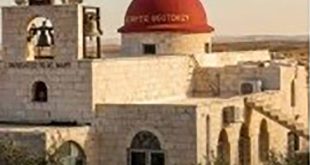
With profound anguish and sorrow, the Romaïan Cultural Society has received news of the horrific crime that has befallen the congregation of St. George’s Church in the town of Hmoud, in the Karak region of Jordan. The tragedy has, thus far, claimed the lives of eight martyrs and left dozens wounded—all of whom have been transported to hospitals for medical treatment, in the hope that, by the grace of God, they may find healing. The Society—much like all Christians throughout the Levant, and the Romaioi community in particular—condemns this atrocious act in the strongest possible terms. We pray that God may enfold the souls of these righteous martyrs in His mercy and grant a swift recovery to those who have been wounded. As faithful Christians, we view these martyrs as righteous souls who now behold the glory of God, and we believe that the suffering of the wounded serves as an experience that draws them ever closer to the Divine.
Our primary duty is to pray for the repose of the souls of our dead and for the healing of the wounds of those who have been injured. This is what we do, reaffirming our hope in the Resurrection, standing in solidarity with those who are suffering, and praying that the Lord may forgive the sins of those who committed this massacre, hoping that they repent and, ultimately, receive forgiveness.
However, our second duty is to recall this painful event within the context of many similar occurrences—perpetrated throughout history by the same kind of evildoers who attacked the Church of Saint George in Hmoud yesterday, seeking to erase Christianity from existence. Not long ago, such evildoers attacked the Church of the Prophet Elias in the suburbs of Damascus, killing dozens of Christians. Others, like them, continue to persevere in various Syrian cities and towns, where Christians face hardships and persecution—often from willingly unidentified sources. These pressures have led to the mass exodus of hundreds of thousands of Christian citizens, who have sought refuge in safer havens.
Over the last two decades, Christians in various countries across the Levant have been subjected to numerous massacres and acts of persecution. This has led to a sharp decline in their numbers, resulting in a shrinking proportion of the Christian population and a diminished presence in Iraq, Palestine, Egypt, and Lebanon. In earlier centuries, Anatolia and North Africa witnessed a near-total or complete disappearance of the Christian population, following massacres that amounted to acts of genocide.
On this day the 25th of October, as we mourn the martyrs of Karak, we also remember Saint Arethas—whose feast day we celebrate today—who, along with hundreds of his fellow citizens, was martyred in the city of Najran in the Arabian Peninsula. We are compelled to ask: where are the Christians of those lands today—the descendants of those who perished in defense of their faith and beliefs? We also recall the great saints of Cappadocia (Basil the Great, Gregory of Nazianzus, and Gregory the Theologian) as well as the saints of Edessa, Mesopotamia, Galatia, Phrygia, Asia Minor, Pontus, and other regions. One must wonder: where are their descendants left in these countries to restore their churches or to kneel in prayer upon their graves?
These perpetrators of evil have eradicated the Christian presence in many countries across the Middle East, and they are now well on their way to complete this process in the few remaining places where Christians still reside. It is our duty not to become mere spectators to massacres—massacres that we unfortunately consign to oblivion, where the memories of the martyrs are reduced to annual commemorations and feasts, devoid of any concrete actions or measures to prevent further loss of life.
We are called upon to reflect deeply on the causes of these tragedies, and to address the frailty that has afflicted us—a frailty that continues to leave us vulnerable to massacres, persecution, displacement, and forced exile. It is our duty to ensure that our prayers are accompanied by a profound awareness of our history and heritage. We must cultivate a strong sense of belonging, ensuring that both our present and future generations recognize themselves as an integral, indigenous component of the Levant—not as outsiders in these lands. It is our duty to stand united and to move beyond the practice of currying favor with governing authorities and influent individuals. We must join hands and assert our right to exist. It is our duty to knock on the doors of the Christian world, reminding them that Christianity originated in our Levant and carried the Gospel to the entire world. Furthermore, we must not feel ashamed to seek support and protection from our brothers in faith and civilization, at a time when our very existence is threatened by imminent dangers.
Our message to all Christians in our lands and across the world is this: the cradle of Christianity is on the verge of becoming a mere relic—a place emptied of its Christians. Unless we join forces—with reason, awareness, courage, and careful planning—we will not survive in our beloved Levant, which risks becoming as devoid of Christians as the Arabian Peninsula, Anatolia, and North Africa. Beware of complacency, forgetfulness, and hypocrisy!